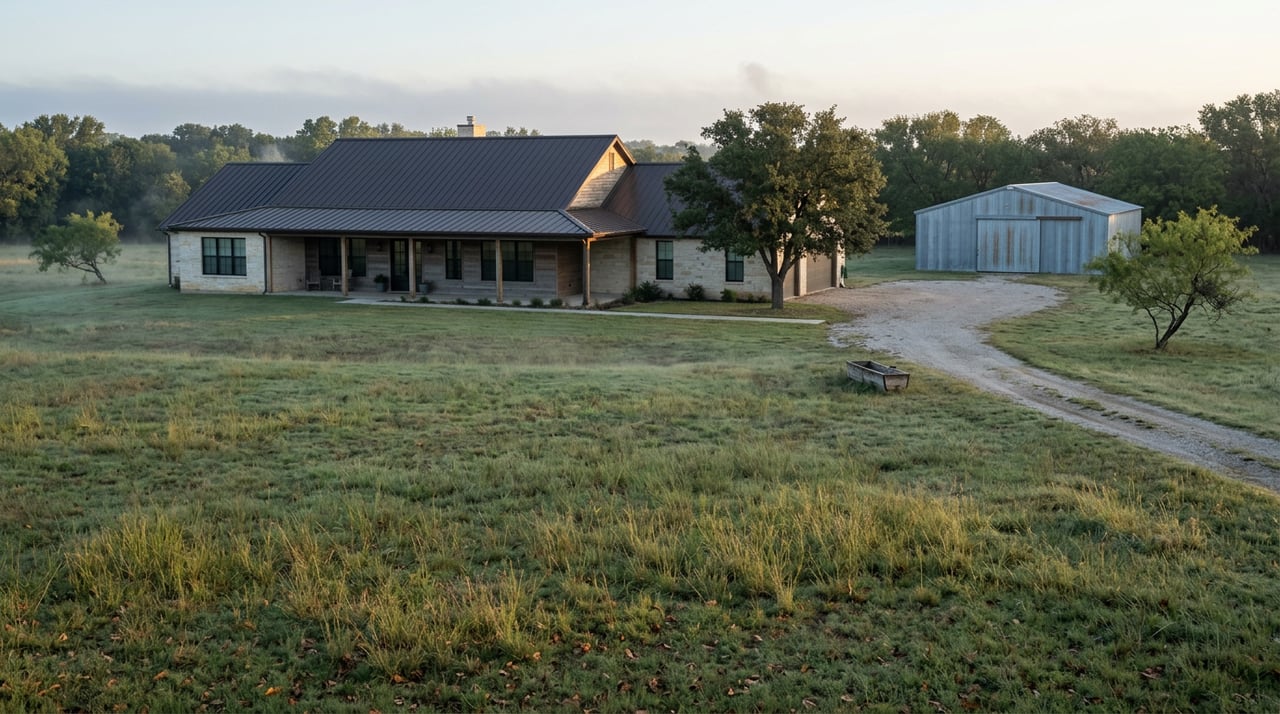
Scroll through land listings around Weatherford and Aledo long enough and a phrase starts repeating: ag exempt. Unrestricted acreage. Low taxes, wide open space. It reads like a bonus, the kind of detail an agent tosses in to sweeten a listing. It isn't a bonus. It's a deal the current owner made with Parker County, and that deal doesn't automatically pass to whoever signs next at closing.
Most buyers moving out to horse country west of Fort Worth assume the low tax bill on a 20-acre tract is simply what the county charges for rural land. It isn't. It's a use-based valuation, and the gap between what that owner is paying and what the county could charge is exactly the amount Parker County will come back for, plus interest, the day the qualifying use stops. That gap has a name: the rollback tax. It's the single biggest number missing from the sticker price on almost every acreage listing in this market, and it changes how a buyer should read every one of them.
What "Ag Exempt" Actually Buys
The phrase gets thrown around as though it means the land pays no property tax. It doesn't. Texas law allows land used for agriculture, timber, or wildlife management to be appraised on its productivity value instead of its market value, under what's formally called a 1-d-1 open-space appraisal. The county still taxes the land. It just taxes it as if it were a hay field or a cattle pasture, not as if it were 20 acres priced for a custom home build in a county that land listings routinely describe as one of the fastest-growing in the country.
That distinction matters because Parker County's appraisal district doesn't grant this valuation based on intent. It evaluates what's actually happening on the ground: whether livestock are running, at what density, and whether the level of production is consistent with what a working operation in that part of the county actually looks like. A single cow grazing 100 acres doesn't qualify. Occasional riding or a couple of hobby goats doesn't qualify either. The district is checking for a working use, not a story.
The Five-Year Bill Nobody Line-Items
Here's the part that catches new owners: when land drops out of qualifying use, whether because a buyer subdivides it, builds outside the agricultural footprint, or simply stops running cattle, the county doesn't just reappraise going forward. It goes back and recalculates what the taxes would have been at market value for the years the land carried the special valuation, commonly a five-year lookback, and bills the difference, with interest historically assessed at around 7 percent annually. On a tract that's been carrying an ag valuation for years while land values in Aledo and Weatherford have been climbing, that difference is not a rounding error. It's the bill for every year the tax office believed the land was working, once it turns out it wasn't.
Parker County's own appraisal district guidance walks through the same math: the rollback tax is the difference between taxes paid under the special appraisal and what would have been paid at market value, applied to the affected years. It's public, it's calculable, and it's the number that should be part of every conversation about a tract that currently carries the exemption.
Why the Discount Doesn't Follow the Deed
The other detail that surprises buyers is that this valuation is not a fixture of the property. It belongs to the applicant who filed for it. Buy a tract that's carried an ag valuation for a decade, and the low tax bill you saw in the listing doesn't transfer to you automatically at closing. The new owner has to file their own application, using Form 1-d-1, with the Parker County Appraisal District, and the statutory deadline for doing so is April 30 of the tax year. Miss that window after closing on a spring purchase, and the property reverts to market value appraisal for the year, no matter what the seller was paying the year before.
There's a use-history requirement layered on top of that. Qualifying land generally needs to have been in agricultural use for five of the preceding seven years. Buyers coming from a suburb who picture a starter herd of goats as a quick path to low taxes are often working against a clock that started well before they signed anything.
The Acreage and Animal Math
Size and stocking density both matter, and they matter in ways that aren't obvious from a listing photo of open pasture. Properties under roughly 10 acres typically don't meet the threshold for agricultural qualification at all, regardless of what's grazing on them. Above that, North Texas appraisal districts, Parker County included, generally lean on an animal-unit framework to judge stocking density: a cow and calf pair typically counts as one animal unit, a horse counts as one, six sheep or goats together count as one, and the number of animal units required scales with the size and quality of the land. A buyer eyeing 12 acres with a single horse and picturing a permanent tax discount is often looking at a stocking rate the district won't accept.
This is where the "unrestricted acreage" language in a listing can be doing two jobs at once. It's genuinely appealing to someone who wants freedom from HOA rules and subdivision covenants. It's also, quietly, a signal that whatever agricultural use currently exists is fragile enough that a change in plans, or even a change in owner, could break it.
What This Means at the Closing Table
Timing decides who owes the rollback tax if a change in use is coming. The assessment attaches to whoever owns the property at the moment the qualifying use actually changes, not necessarily whoever owned it when the ag valuation was first granted. If a seller clears the pasture or stops the cattle operation before closing to prep the land for a buyer's building plans, the rollback typically lands on the seller. If the change happens after the buyer takes title, even if that buyer always intended to build rather than farm, the bill is theirs.
That means the smart move for a buyer eyeing a tract with residential plans isn't to assume the exemption is irrelevant to them. It's to ask the seller and their agent, before writing an offer, exactly what the land's current qualifying use is, how long it's been in place, and whether the intended change in use is something the seller plans to trigger before closing or something the buyer will inherit. That single conversation determines whether a five-figure tax bill shows up in year one of ownership or never shows up at all because the timing and paperwork were handled correctly.
A Short Checklist Before You Write an Offer
A few questions turn this from a surprise into a manageable part of due diligence.
Ask whether the tract currently carries a 1-d-1 agricultural or wildlife management valuation, and for how many consecutive years. Ask what the actual qualifying use is, not just what the listing implies. Confirm the acreage against Parker County's animal-unit expectations for that type of land. If the plan is to build a home on part of the tract while keeping the rest in production, ask how the appraisal district treats split use on a single parcel. And if the deal depends on the buyer picking up the exemption after closing, put the April 30 filing deadline on the calendar the day the contract goes under review, not the day taxes come due.
None of this changes whether Parker County land is worth buying. Land here has genuine long-term appeal, and the growth pushing prices up across Aledo and Weatherford isn't slowing. It does change what "cheap to hold" actually means on a specific tract, and that's the number worth knowing before an offer goes in, not after the first tax notice arrives under new ownership.
If you're comparing acreage listings around Weatherford, Aledo, or anywhere else in Parker County and want a second read on what a specific tract's tax history and use qualification actually mean for your plans, Cassidy Calman and the CARE Team can walk the numbers with you before you write an offer, not after.
A Few Straight Answers
Does selling the land itself trigger the rollback tax? No. A sale alone doesn't trigger it. The rollback is tied to a change in qualifying use, which can happen before or after a closing depending on what the seller or buyer actually does with the land.
If I buy land that's currently ag-exempt, do I automatically keep the lower tax rate? No. The valuation belongs to the person who applied for it. A new owner has to file their own 1-d-1 application with the Parker County Appraisal District, and the deadline is April 30 of that tax year.
Is wildlife management a way around the livestock requirements? Texas law allows wildlife management as a qualifying use alongside traditional agriculture, and some owners use it to maintain the valuation without running livestock. It still requires documented, consistent use that meets the appraisal district's standards, so it's worth confirming with Parker County directly rather than assuming it applies automatically to a given tract.